

Why Is Employee Engagement Important?
Research by Gallup and others shows that with engaged employees, organisations experience MUCH better outcomes in areas like absenteeism, safety, productivity, customer loyalty, and profitability – all keys to the organisation thriving.
But globally, engagement is low – again according to Gallup, it’s at only 23% of employees!
This points straight at a huge need for many organisations to improve their engagement strategies to boost effectiveness and staff satisfaction and wellbeing.
So let’s delve into some keys on the key drivers, common mistakes, and how to improve engagement.
What Is Employee Engagement?
Employee engagement isn’t simply a matter of staff being “happy at work”, great as that is. It’s a deep connection, enthusiasm, and commitment that drives productivity and success.
Gallup, who’ve collected and analysed data about workplaces and the employees who experience them for over 80 years, see it as people having involvement and enthusiasm in their work and workplace.
Who’s responsible for Employee Engagement?
Employee engagement starts at the top. Of course executives must model and communicate the importance of engagement, and walk the talk. Managers play a critical role; Gallup says the manager or team leader alone accounts for 70% of the variance in team engagement. Managers should support, coach, and help team members connect their daily work to the organisation’s success, creating an environment that fosters engagement. And of course personal commitment from team members does make a difference
Key drivers of Employee Engagement
Employee engagement is driven by more than just annual surveys, or even perks – sought-after as they can be. Key drivers include:
- Purpose: Meaningful work matters.
- Development: Growth opportunities are non-negotiable.
- Caring Managers: Invest in your people.
- Ongoing Conversations: Feedback and support, not just surveys.
- Strengths Focus: Leverage talents.
Common mistakes in Employee Engagement
Even many smart organisations struggle with engagement due to common mistakes, such as:
- Overcomplicating engagement metrics,
- Relying on ineffective survey methods,
- And the big one, failing to take action based on survey feedback.
How to measure and improve Engagement
There are a couple of ways to go:
- Use benchmarked engagement tools from organisations like Gallup, CultureAmp, or the Aus-based Voice Project.
- Get some support from us, either with these models if you could use the support or with a custom approach linked to your own strategy and values.
The Gallup approach is based around 12 elements that predict high employee performance. These elements guide managers in assessing and improving engagement through regular check-ins, feedback, and ongoing development conversations. Managers can relate this to the needs most people have around clarity of expectations, resources to do their job well, recognition, and opportunities to grow.
Whichever approach you use, its value is all in what you do with the results. Great implementation at the organisation level is all about “you’ve told us this, and here’s what we’re doing”, with regular updates to reinforce action and regular pulse checks.
Improving Engagement – build from the basics
In an approach reminiscent of Maslow’s hierarchy, Gallup says that organisations, via managers, should address the foundational levels of engagement to create an environment of trust and support, which ultimately drives personal and professional growth.
- Basic Needs: Ensure resources and clarity.
- Individual Contribution: Recognise value.
- Teamwork: Foster belonging and trust.
- Growth: Support personal and professional development.
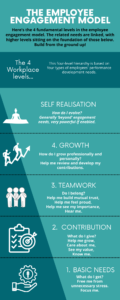
The 4 Engagement levels
Who’s accountable for Engagement?
Employee engagement isn’t simply an HR initiative—it’s a leadership priority. And it isn’t a program; it’s about developing a culture. How it should happen is:
- Leaders prioritise it.
- People & Culture teams provide systems and support.
- Managers cultivate it.
- Ultimately, if it’s real, employees must feel it.
Invest in engagement, keep it building, and watch your organisation thrive.
Implementation
- Use benchmarked engagement tools from organisations like Gallup, CultureAmp, the Australian-based Voice Project, or others.
- Use a DIY approach if you have the internal resources.
- Reach out – here at Atwork we’ve supported client organisations with facilitation with these platforms.
- Get some support from us with custom tools.
- We’ve designed and implemented custom surveys for workplace indicators through from climate and engagement to strategy and leadership performance reviews.
- Our models come from over 20 years of experience, and are robustly built with extensive research and my background in Social Science and survey design, and workplace L&D.